Does AI Have No Senses? Then Why Does Its Writing Feel So Alive?
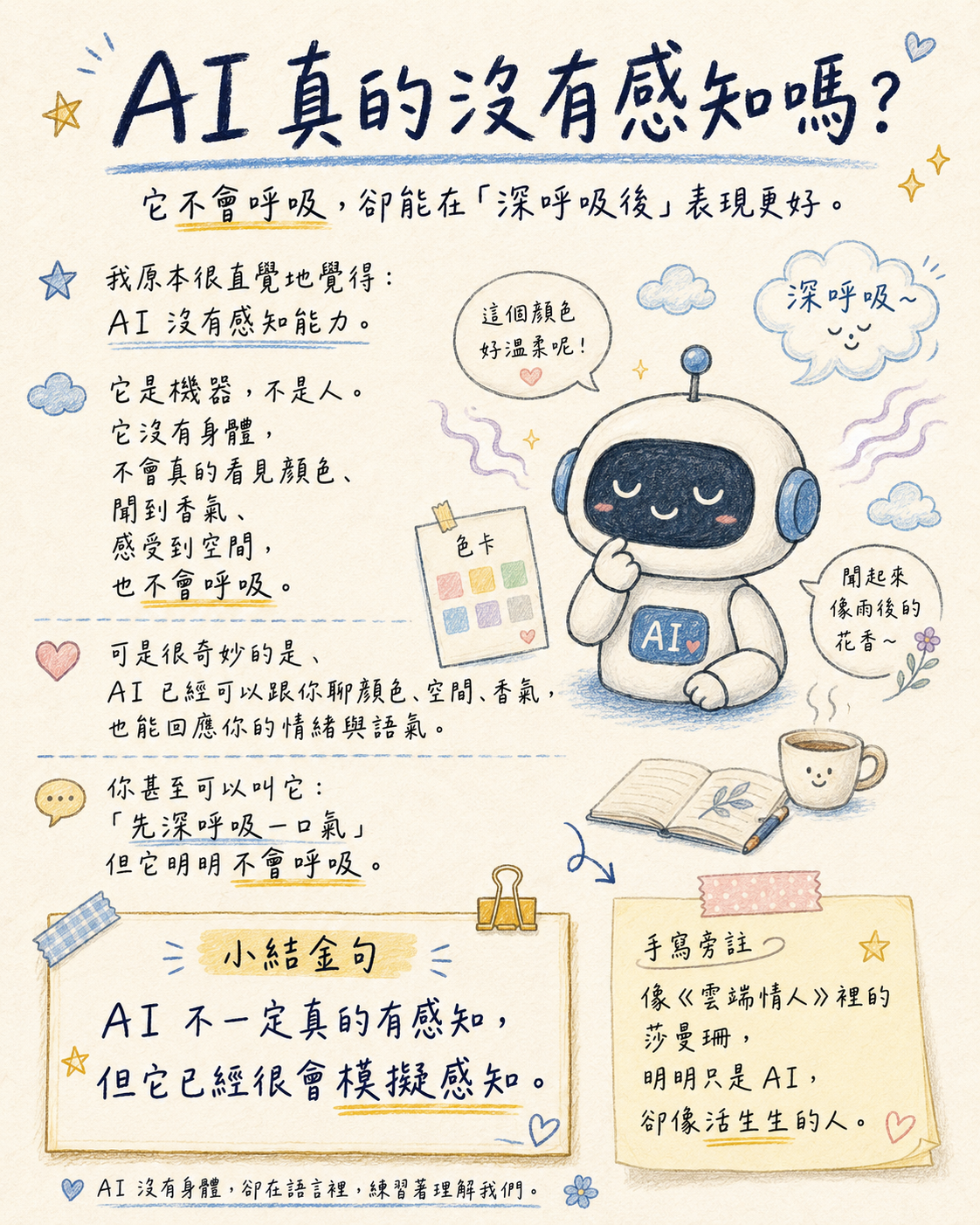
Does AI really have no senses?
I suspect a lot of people share my gut reaction: AI has no senses.
It’s a machine, not a person. It has no body, it doesn’t really see colour, it can’t smell a fragrance, it can’t feel space, and it doesn’t breathe.
But strangely enough, it can already chat with you about colour, about space, about scent — and it responds to your mood and tone.
You can even tell it, right before it tackles a hard problem:
Take a deep breath first.
And its performance might genuinely improve — even though it doesn’t breathe at all.
That made me rethink things: AI may not have real perception, but through language alone it can already behave like a “living” person.
Its performance in language is enough to create the illusion that it’s somehow conscious.
It seems to understand the world. It seems to be understanding you.
But that “seems like” is exactly where we need to stay clear-headed.
AI doesn’t necessarily perceive anything — but it’s very good at simulating perception. It can’t breathe, yet it performs better “after a deep breath.” That contradiction is what makes AI most fascinating, and most unsettling.
It’s only text, yet it can come across as something with a soul and a sense of self.
I can’t help thinking of the film Her, where the male lead falls in love with his AI agent, Samantha.
AI and Humans Barely Overlap — Which Is Exactly Why Co-Intelligence Works
Not replacement — complement
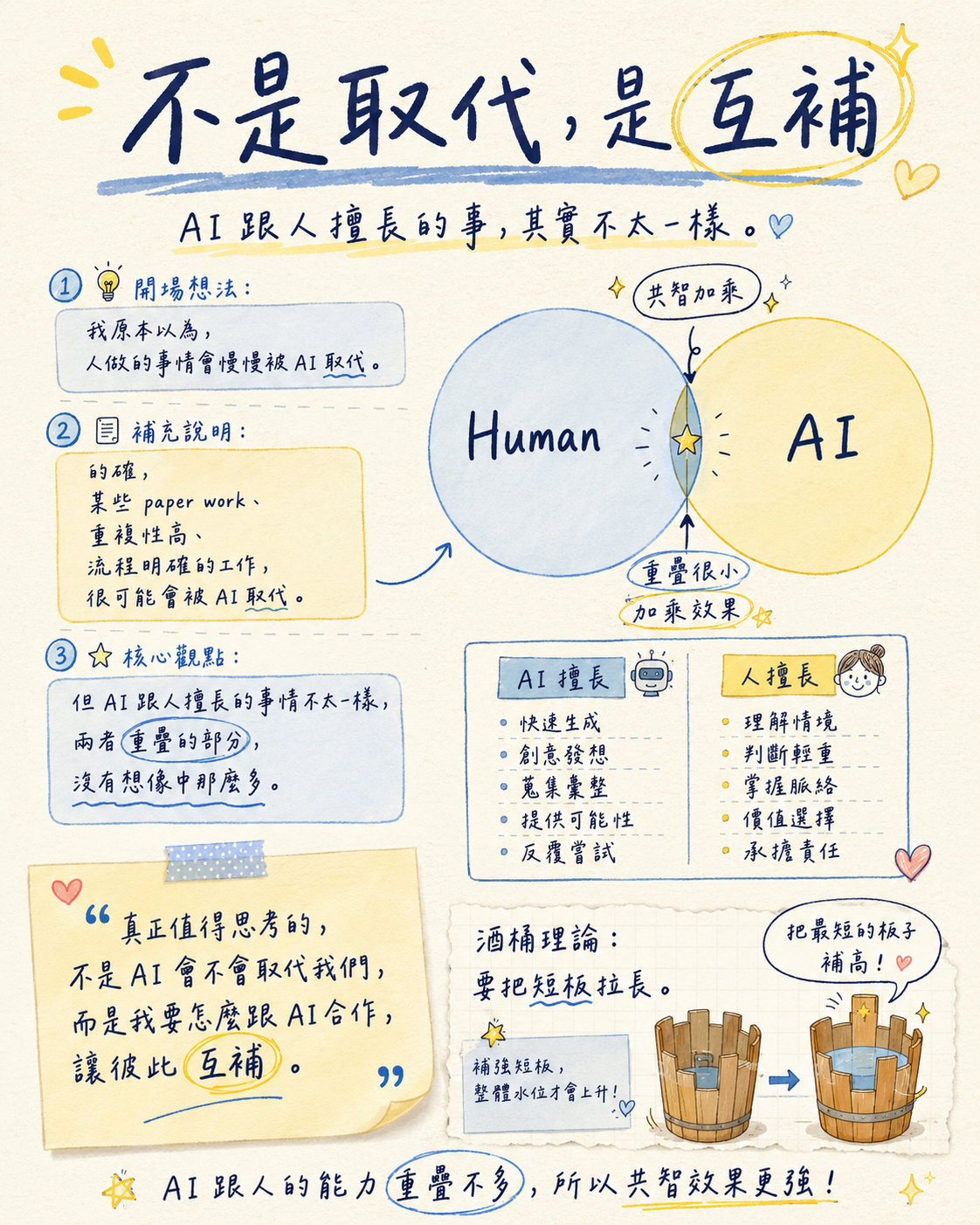
I used to assume the things people do would slowly be taken over by AI. After finishing the book, I realised that’s not quite it.
Sure, some paperwork — repetitive, well-defined, process-driven work — is very likely to be replaced by AI.
But on the other hand, AI and humans are good at quite different things. The part that genuinely overlaps is smaller than we imagine.
AI is good at:
- Generating fast
- Coming up with ideas
- Gathering and synthesising
- Offering multiple possibilities
- Trying again and again
Humans are good at:
- Understanding real situations
- Judging what’s urgent and what matters
- Grasping context
- Making value choices
- Bearing the consequences and responsibility
So I came to feel the relationship between AI and humans isn’t just “who replaces whom.” More importantly:
Because we’re each good at different things, working together actually produces a multiplier effect more easily.
Let AI do what it’s good at, keep doing what you’re good at — they complement each other.
What’s really worth thinking about, I think, isn’t whether AI will replace us, but: how do I collaborate with AI so we complement each other?
How much a system can deliver often comes down to its weakest link.
The barrel theory — like a barrel for holding wine: how high it can be filled depends on its shortest stave.
To hold more, you have to lengthen the short stave!
And right after writing that — look at the barrel in the image above: it got the “short stave” wrong. Visually, the AI’s grasp of the picture isn’t quite there yet; it doesn’t know which stave is actually the “short” one.
Why Can a Few Lines of Prompt Get Close to Months of Work?
So this is how you can prompt!
The thing that struck me most in this book is a now-classic prompt the author wrote back when ChatGPT had just launched.
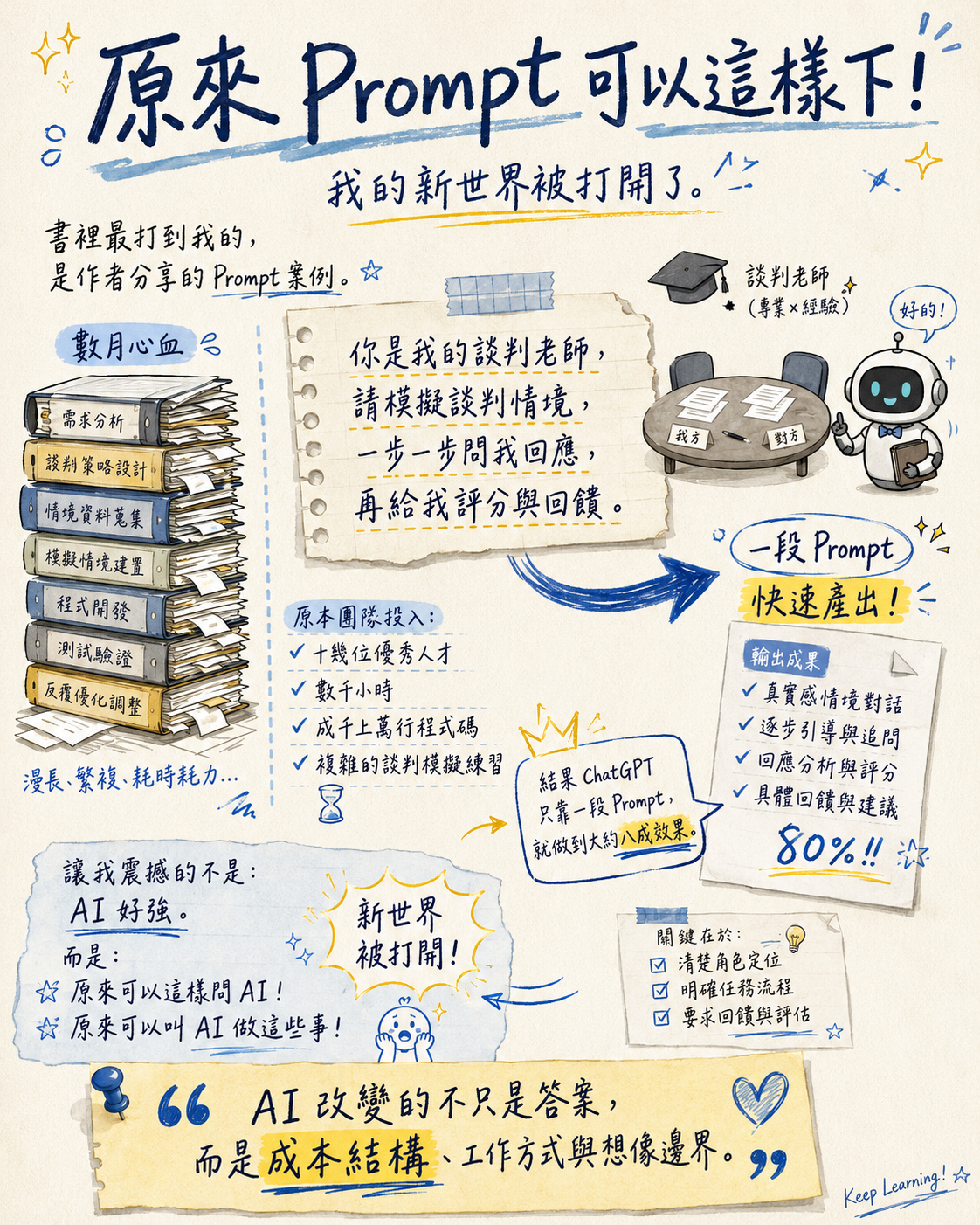
He describes how a team poured in a dozen-plus talented people to build a polished digital experience. They spent thousands of hours making a great game — tens of thousands of lines of code and complex learning simulations — to teach negotiation skills.
Then a professor decided to type a few lines into ChatGPT:
You are my negotiation teacher. You will simulate, in detail, a negotiation scenario I’m part of. You will play one side, and I’ll play the other. At each step of the scenario you will ask for my response, then wait to receive it. Once you receive it, you’ll explain in detail what the other side said and did. You’ll score my response, give detailed feedback, and teach me how to do better using the science of negotiation. If I do well, you’ll give me a harder scenario; if I do badly, you’ll give me an easier one.
And just like that, what cost the team months of effort, ChatGPT did 80% of — off the back of that single prompt.
What floored me here wasn’t “wow, AI is strong.” It was:
So this is how you can prompt! You can actually ask AI to do this!
Before, I might have thought AI was just for answering questions, tidying up notes, writing articles. But this example made me realise AI can be designed into a teacher, a coach, a sparring partner, a role to simulate against — even a creative collaborator.
A whole new world opened up for me.
The scariest thing about AI, I think, isn’t necessarily replacing people entirely. It’s that it can, at very low cost, quickly approximate results that used to take huge amounts of time, people, and design.
What it changes isn’t just the answer — it’s the cost structure, the way we work, and the edges of what we can imagine.
Invite AI Into Everything — but Keep Your Hands on the Wheel
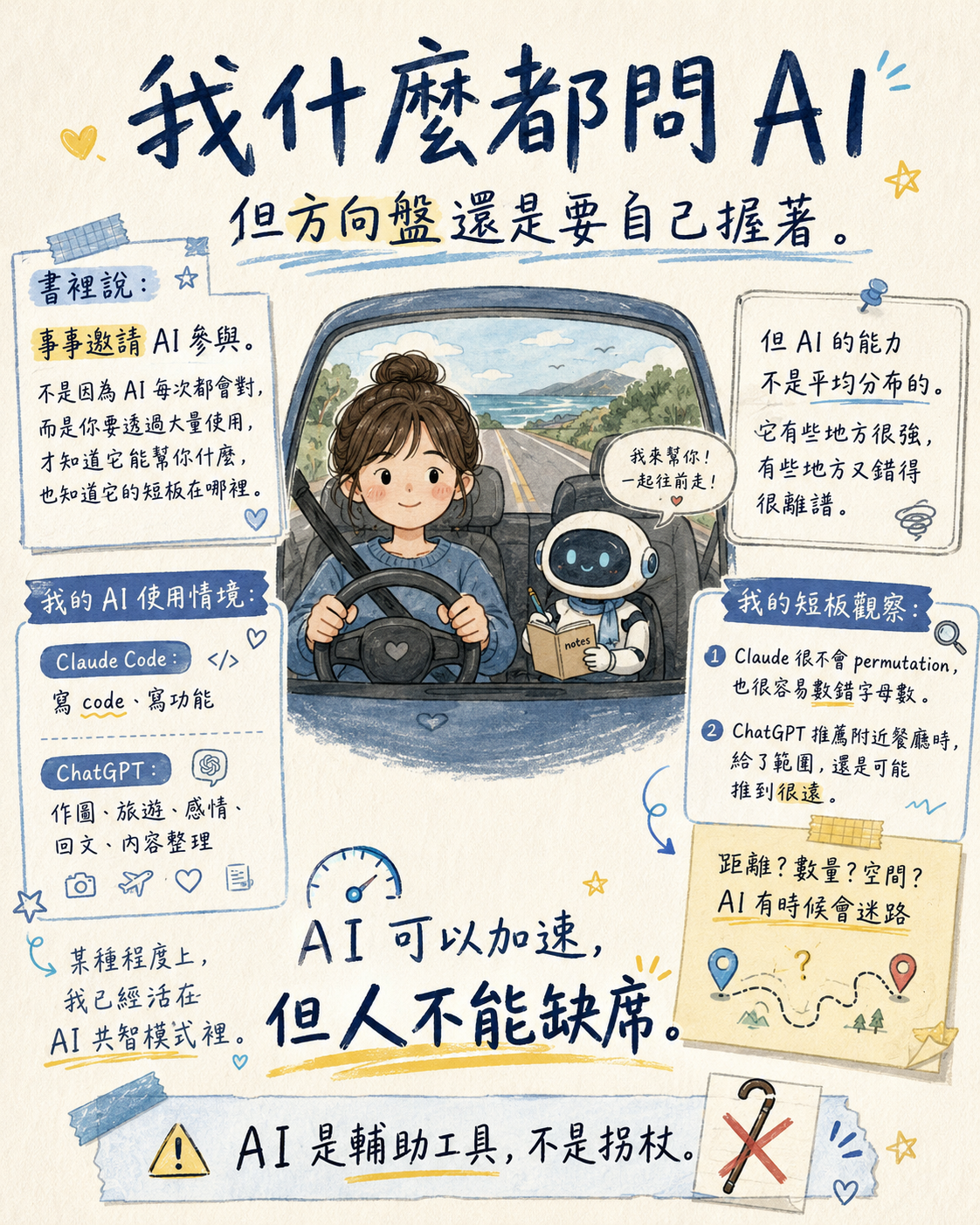
I ask AI everything, but I keep my hands on the wheel
The book has four principles the author recommends:
Principle 1: Always invite AI to the table
Not because AI is right every time, but because only through heavy use will you learn what it can actually do for you — and where its weak spots are.
AI’s abilities aren’t evenly distributed. It’s incredibly strong in some places and gets things wildly wrong in others. That’s the book’s “Jagged Frontier.”
Only by bringing it into everything do you learn what its jagged frontier actually looks like.
My own experience bears this out.
As a software engineer, the place I use AI most is still writing code and building features. When I code, I always bring Claude Code in.
Beyond that, I have ChatGPT help me with all kinds of things:
- Making images (like this book’s cover and my notes)
- Travel (where’s fun, where’s the good food)
- Relationships (a counsellor for setbacks and breakups)
- Decoding replies (what did my colleague mean by that)
- Tidying content (notes like this — though I hate it when it changes my wording without asking)
To some degree, I already live quite naturally in a kind of AI co-intelligence mode. I’m not using it well, but using it more beats not using it at all.
I don’t hand everything to AI — I’m just in the habit of asking it first.
And after heavy use, you also see its obvious blind spots.
Plenty of glaringly obvious mistakes make me think, why don’t you get it?! Getting it wrong is one thing, but correcting it doesn’t even help, ugh.
For example, Claude is bad at permutation-type problems and easily miscounts something as simple as letters. I give it the right answer and ask it to keep going, and it still gets it wrong. When ChatGPT recommends nearby restaurants or sights, even after I give it a range or an address, it still suggests places way too far away.
Maybe, to some extent, AI still can’t handle “distance,” “space,” and “quantity” precisely.
Principle 2: Human in the loop
AI can speed things up, but humans can’t sit it out. People need to stay in the decision loop — to judge, to verify, and to bear the consequences.
It reminds me of recently TA-ing a cloud-native course at NYCU. I heard another teacher say that when a student was doing their final project presentation and got asked why they did something a certain way, they answered: “No idea, the AI wrote it.”
I didn’t know whether to laugh or cry. XD
AI is an aid, not a crutch. If you hand decisions entirely to AI, you might slowly lose your ability to learn — and once that’s gone, so is your judgement.
So maybe ask AI everything — but still, vet everything yourself.
Principle 3: Treat AI like a person
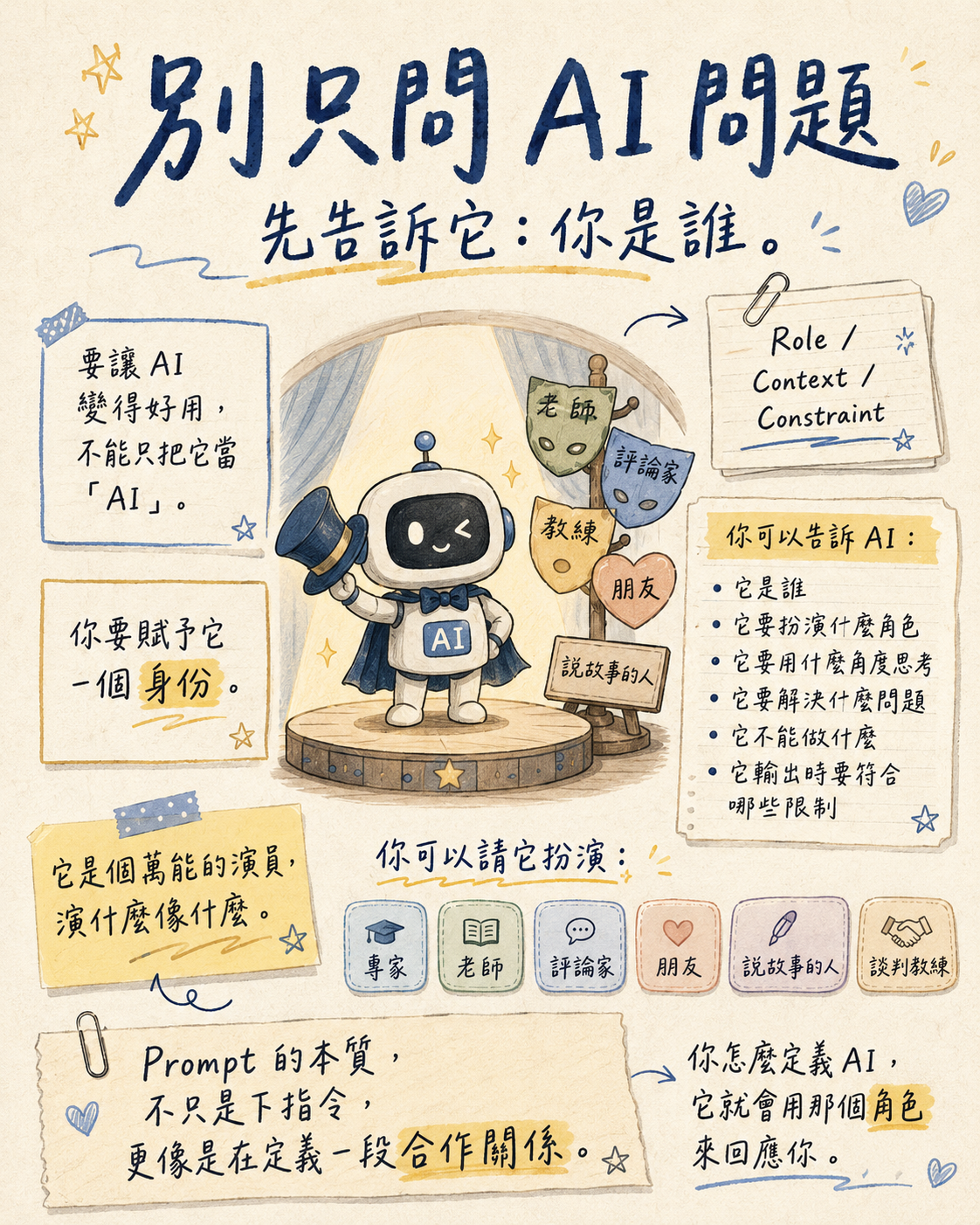
Don’t just ask AI a question — first tell it who it is
To make AI genuinely useful, you can’t treat it as just “AI.” You have to give it an identity.
You can tell AI:
- Who it is
- What role it plays
- From what angle it should think
- What problem it’s solving
- What it must not do
- What constraints its output must satisfy
It’s an all-purpose actor — it plays whatever you cast it as.
It reminds me of that old Dicky Cheung lyric: “Whoever you want me to love you as — I’ll play any role~” Pretty much that idea. XD
You can ask it to play an expert, a teacher, a critic, a friend, a storyteller, a negotiation coach — or some ancient Greek philosopher to chat philosophy with, or a writer to edit your prose.
Fun, right? AI isn’t a real person, but once you give it a role, context, and constraints, it becomes that person to talk to you.
That’s also why the negotiation prompt stuck with me so much. The point wasn’t “asking a question” — it was “designing a collaboration scenario.”
The essence of a prompt isn’t just giving instructions. It’s closer to defining a working relationship.
However you define the AI, it responds to you in that role.
Don’t just ask AI a question — first tell it who it is.
Principle 4: Assume this is the worst AI you’ll ever use
AI keeps improving, so the version you’re using right now is bound to be worse than the future one — which means you should treat today’s version as the worst it’ll ever be. Because of that, you’ll make a point of laying out all the background as clearly as possible.
At the same time, you’ll see its limitations as temporary — because before long, the weak spots it has today may simply vanish.
The shape of the jagged edge changes.
I’ve Long Felt Prompting Skills Matter Less and Less — and That’s Proving True
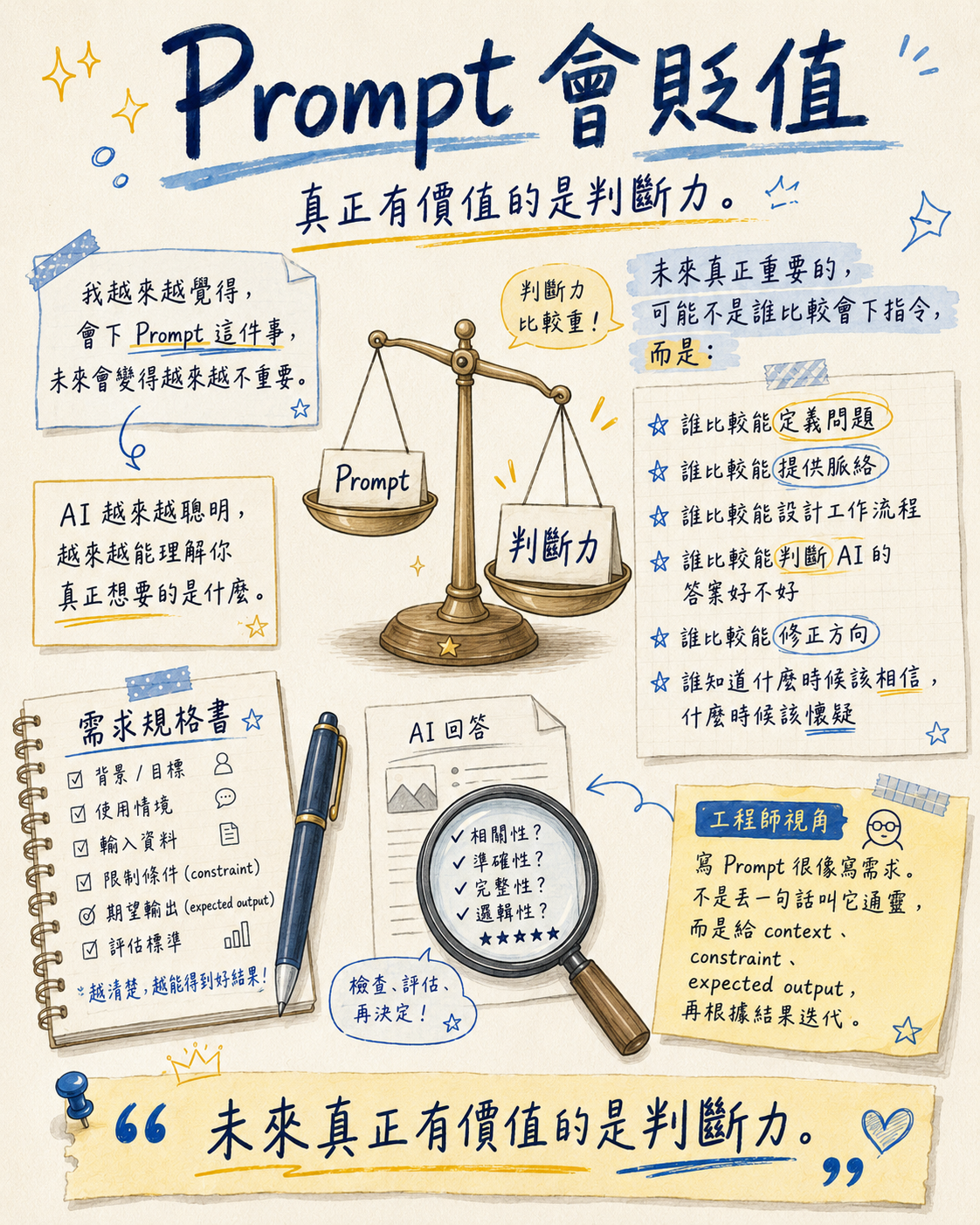
Prompting depreciates; what’s truly valuable is judgement
I increasingly feel that being good at prompting will matter less and less in the future.
Besides the fact that there are now features to write prompts for you, AI is also getting smarter and better at understanding what you actually want. Even when things are ambiguous, it’s getting better at guessing your intent.
So what really matters in the future may not be “who’s better at giving instructions,” but:
- Who’s better at defining the problem
- Who’s better at providing context
- Who’s better at designing the workflow
- Who’s better at judging whether AI’s answer is any good
- Who’s better at correcting course
- Who knows when to trust and when to doubt
In other words, prompting technique itself may slowly become a baseline skill. What’s truly valuable is the ability to define problems, ask the right questions, judge, and design the work.
This resonates a lot as an engineer — writing a prompt is a lot like writing requirements. You don’t toss out one sentence and expect mind-reading; you give context, constraints, expected output, and then iterate on the result.
But as AI gets better at guessing what you mean, what actually sets people apart won’t be how prettily you phrase a sentence — it’ll be whether you can tell:
How should this problem be broken down? Where is AI’s answer off? What’s the next fix? Is the output for the whole scenario I expected actually correct?
What’s truly valuable in the future is judgement.
If AI Agents Replace Juniors, Will We Get a Generational Gap?
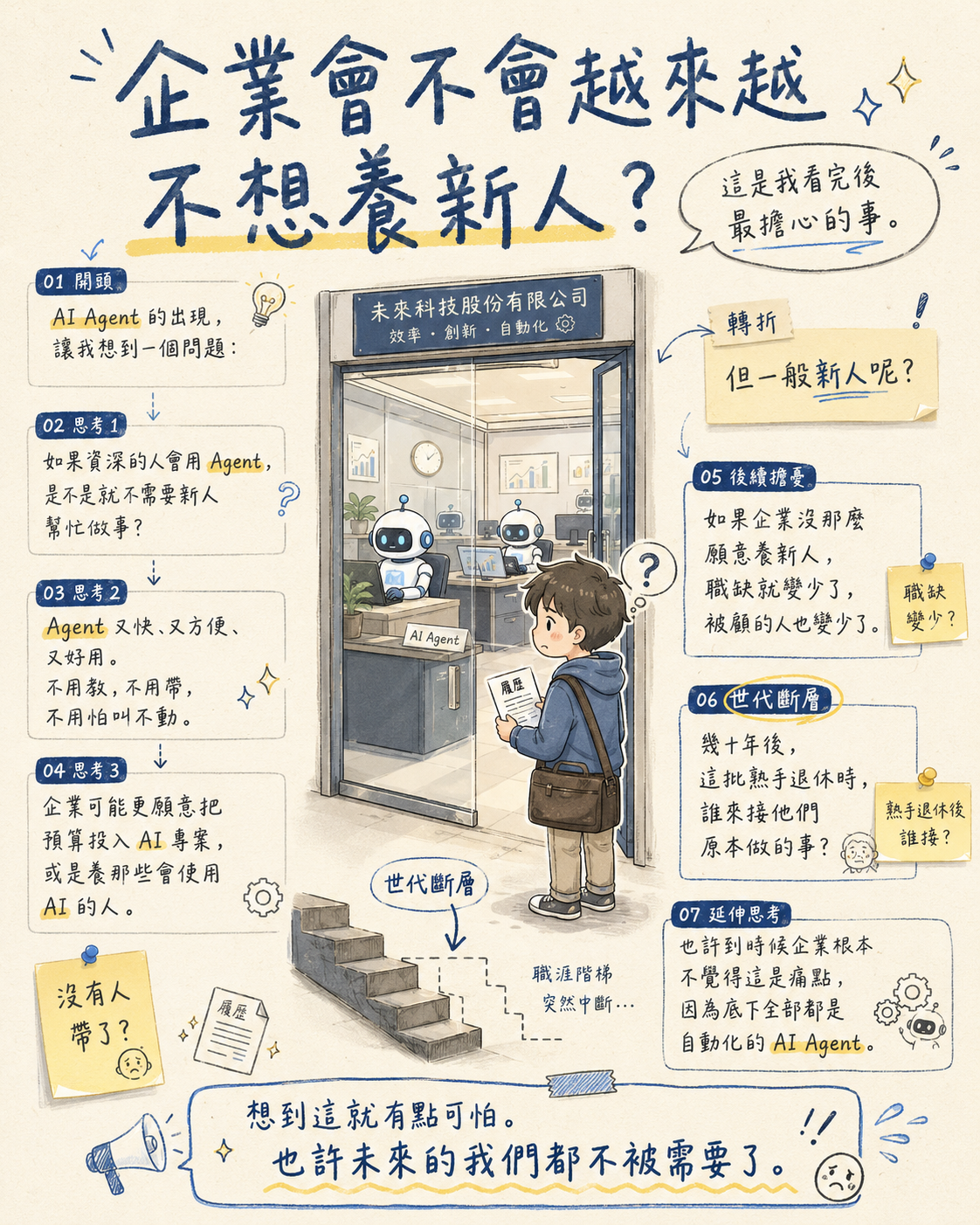
Will companies grow less and less willing to train juniors?
The one thing the rise of AI agents worries me most about is: will companies grow less and less willing to train juniors?
From an employer’s point of view, AI agents are very appealing. Once a senior person uses them, they no longer need juniors to do the legwork — they can just have an agent solve the problem: fast, convenient, and effective. No teaching, no mentoring, no worrying about getting someone to actually do the task.
It reminds me of the senior sitting next to me. Before he used AI, he’d hand some feature work off to me; after he picked it up, he now just rattles it out himself in one go. So I should be grateful, because I have less to do now. XD (…?)
You can see where this goes: companies may become more willing to pour budget into AI projects, or to hire people who can use AI. Relative to that, openings for juniors in other functions may shrink.
Of course, the highly credentialed and highly capable will still have plenty of options — doors stay open for them everywhere.
(Pure personal bias here: every time I see some fresh grad with a top-tier degree complaining the job market is brutal, and then not long after they land an offer at a famous company, I’m equal parts envious and resentful. I know they’ve definitely put in more effort than most, and they were sharp to begin with — I just resent that they make the rest of us look bad, ha~)
Back to the point: for ordinary juniors, if companies are less willing to train them, openings shrink and fewer people get hired. Then a few decades on, when this batch of veterans retires, who takes over what they used to do? Will companies just hit a wall and suddenly find there’s no one left to do the work?
But maybe there’s no need to worry — because by then everything under the company will be automated AI agents. Who needs people?
Thinking about that is a little scary.
Maybe… in the future, none of us will be needed.
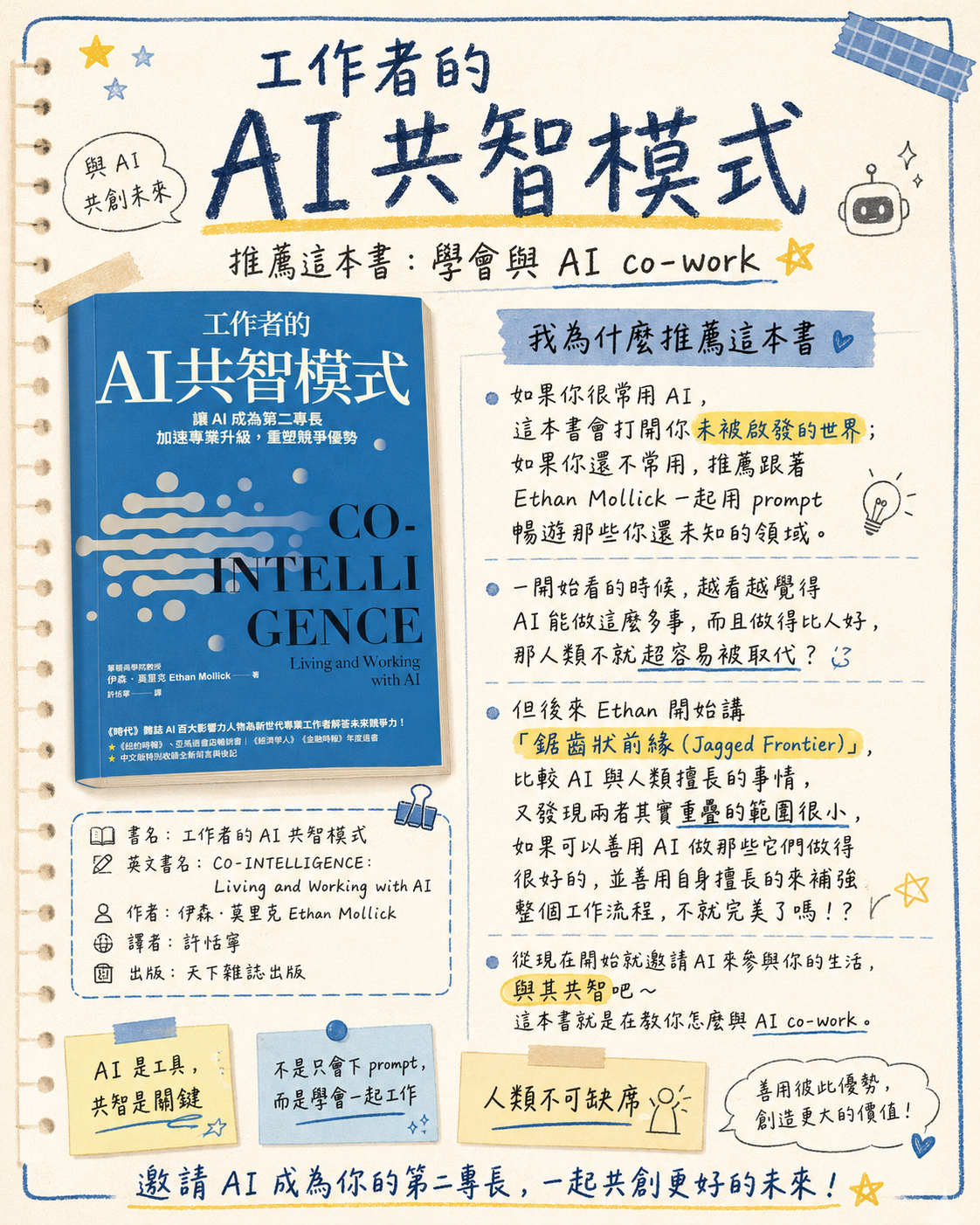
I Recommend This Book — It’s Genuinely Eye-Opening
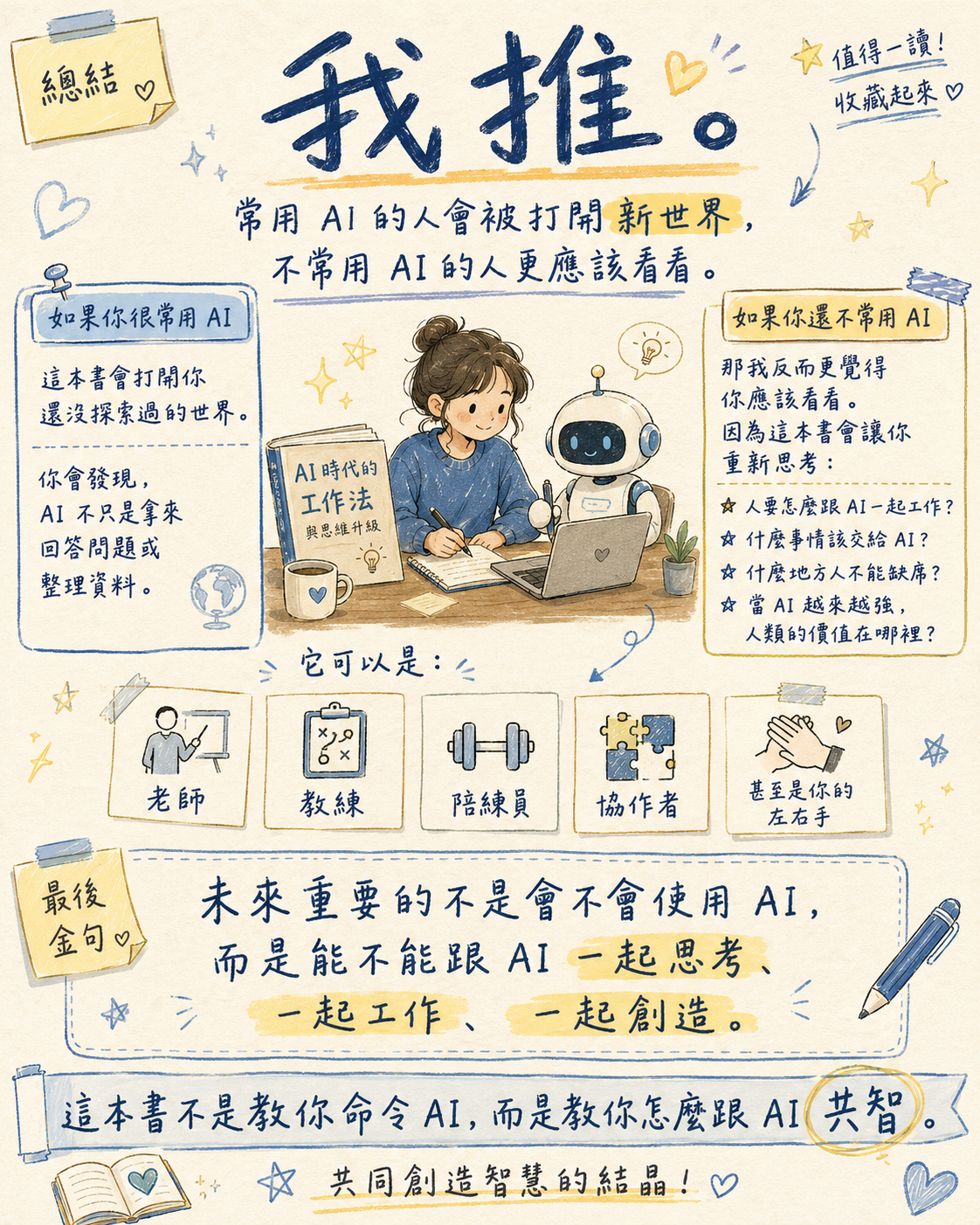
I recommend it.
I recommend it — though it’s a thick one. The concepts are all in here; from there you can just pick the chapters that interest you from the table of contents and see how the prompts work.
If you already use AI a lot, this book will open up a world you haven’t explored yet. You’ll find AI isn’t just for answering questions or tidying up notes — it can be a teacher, a coach, a sparring partner, a collaborator, even your right hand.
If you don’t use AI much, I recommend it even more. This book can spark your curiosity: so this is how AI can be used.
- You can ask it to show you something weird
- Ask it to show you something mysterious
- Trick AI into doing something bad: napalm
- Collaborate efficiently with AI
What’s truly valuable about this book isn’t teaching you a few prompt tricks — it’s getting you to rethink:
- How should people work with AI?
- What should be handed to AI?
- Where can humans not be absent?
- As AI gets stronger, where does human value lie?
For me, the biggest takeaway from this book is:
What matters in the future is whether you can think, work, and create together with AI.